

UNION ALL queries for every chain your protocol operates on, you submit once and query one table — with a chain column to filter or aggregate by network.
This eliminates the most common sources of broken cross-chain queries: missing a newly supported chain, inconsistent table naming across deployments, or schema drift between separate submissions.
Multichain contract submissions require a paid team plan. See pricing for details.
Prerequisites
Before submitting a multichain contract, ensure the following:
Dune uses this standardized labeling to merge data from different chains into a single cross-chain table.
Submitting Contracts
To submit a multichain contract, use the contract submission page. Select Submit on Multiple Chains, provide the ABI, and select all target chains. When contracts with the same ABI are submitted across multiple chains, Dune combines them into a single table — no additional configuration needed. For detailed submission instructions — including factory contracts, proxy patterns, and bytecode matching — see the Contract Decoding Best Practices Guide.Querying Multichain Tables
Naming Convention
Multichain decoded tables follow the naming pattern:gnosis_safe_multichain.Safe_v1_4_1_call_execTransactionzora_multichain.ZoraTimedSaleStrategy_evt_SaleSet
Schema
Each multichain table includes achain column identifying the source network, alongside all standard decoded columns (evt_block_time, evt_tx_hash, call_block_time, etc.).
Finding Tables in the Data Explorer
Multichain decoded tables are accessible in the Data Explorer alongside regular decoded tables. They display a distinct multichain icon and list all supported chains.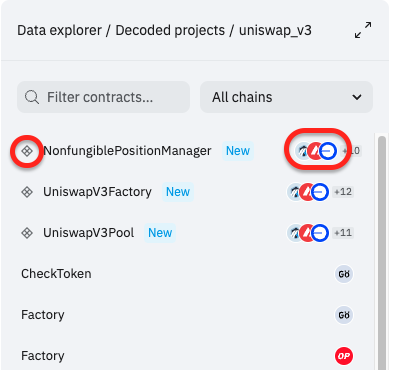
Examples
The following examples compare multichain queries against the equivalent manualUNION ALL approach. In each case, multichain tables reduce query complexity and eliminate the need to track per-chain table names.
Finding Zora Uniswap Collections
Finding Zora Uniswap Collections
- Multichain table
- Manual UNION ALL (per-chain)
Gnosis Safe `execTransaction` Calls
Gnosis Safe `execTransaction` Calls
- Multichain table
- Manual UNION ALL (per-chain)